The Beginning of the Mystery

For decades, people living across the Himalayan regions have spoken about something they cannot fully explain a presence that feels real, yet remains unseen. They call it the Yeti.

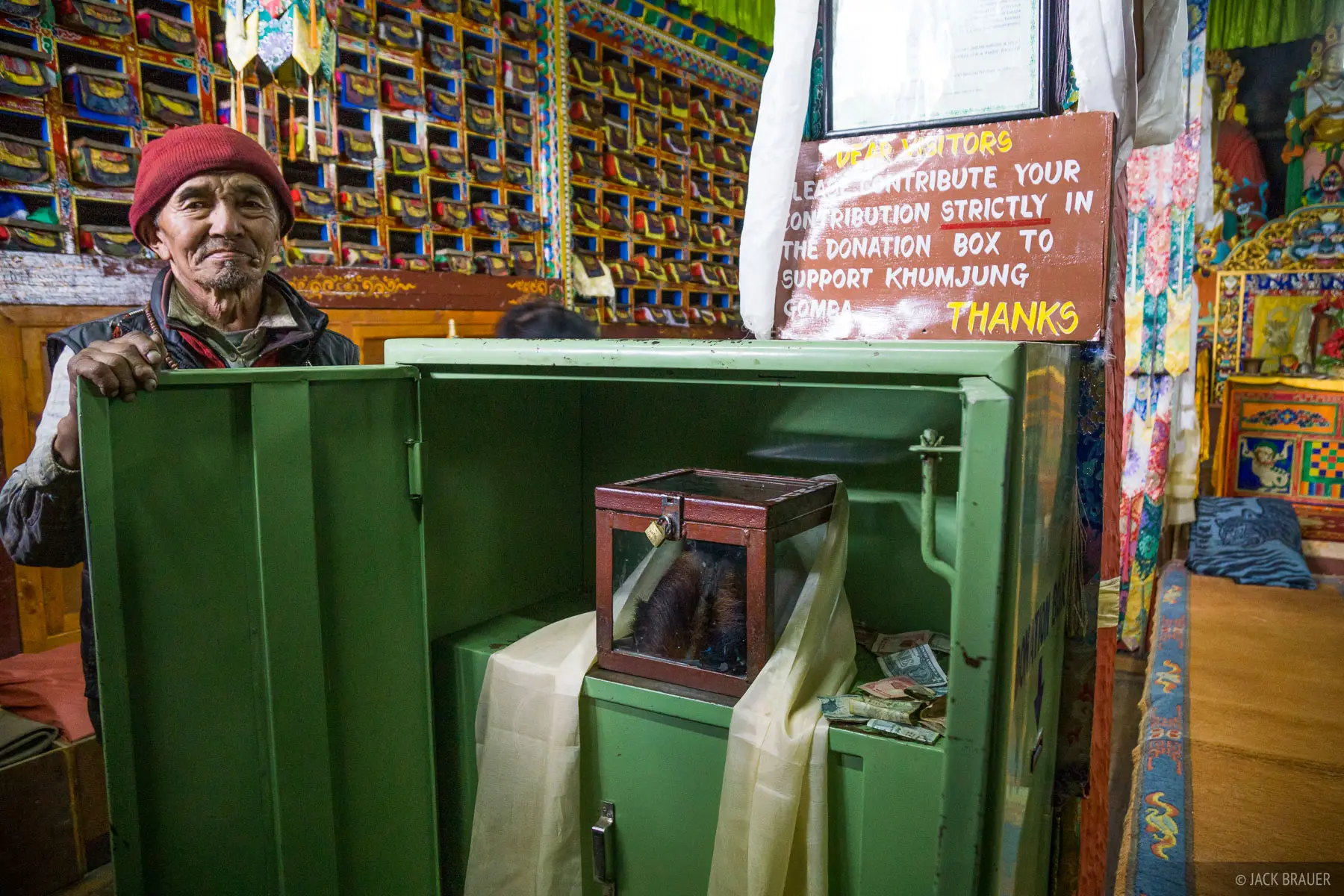
One of the most talked-about claims comes from the Pangboche Monastery, where locals believed that a preserved Yeti head once existed. This belief was strong enough to attract researchers, who visited the monastery and collected samples, including strands believed to be hair.

As early as 1937, multiple expeditions reported at least seven different footprint discoveries. More strikingly, two individuals claimed they had seen the creature with their own eyes. These were not isolated rumors they were observations that slowly built into a larger narrative.

But the roots of this mystery go far deeper. References to a Yeti-like being can be traced back more than a thousand years, including mentions in pre-Buddhist traditions. Long before modern science tried to question it, the Yeti already existed in stories, beliefs, and cultural memory.

The 2008 Incident That Shocked Everyone

In 2008, at an altitude of nearly 12,000 feet in Arunachal Pradesh, Indian Army personnel were engaged in road construction in a remote mountainous area. It was routine work until something happened that could not be explained.

A worker went to a nearby market, purchased supplies, and began his return journey before sunset. But he never made it back to the camp. Hours passed. Night fell. There was no sign of him.

The next morning, local army personnel traveling along the same route noticed him sitting near the roadside. At first glance, nothing seemed unusual. He appeared to be resting, possibly intoxicated.

But as they moved closer, the situation changed instantly. He was dead. His neck was broken. There were no signs of struggle. No blood. No visible injuries anywhere else on his body. His belongings phone, money were still lying beside him, untouched.

The details of the incident ruled out the obvious explanations. It was not robbery nothing had been taken. It was not an accident the body was found sitting upright, not fallen.

There were no cuts, no wounds, no evidence of any physical struggle. The only visible damage was the broken neck. Medical experts later confirmed that the force required to break the neck in such a manner was extremely high something very difficult for a human to achieve. At the same time, there were no bite marks or claw marks, making it unlikely that a wild animal was responsible.

The case remained suspended between two possibilities neither human nor animal.

The Only Evidence Found

During the investigation, police recovered two pieces of evidence:
a single strand resembling hair, and a footprint near the site. When analyzed, the strand did not match any known human or animal. This single detail was enough to shift the narrative. Local residents did not hesitate. For them, the answer was clear. They believed this was the work of the Yeti.

Years later, on April 29, 2019, the Indian Army reported another unusual finding. A mountaineering expedition team discovered massive footprints measuring 32 by 15 inches near Makalu Base Camp. The Army confirmed that photographic evidence had been collected and would be examined scientifically.

Once again, the mystery resurfaced stronger than before.

The Photograph That Changed Everything

The global obsession with the Yeti can be traced back to a single moment in 1951.

British mountaineer Eric Shipton and his companion Michael Ward were exploring the Menlung Glacier while searching for an alternative route to Mount Everest. During their expedition, they came across a series of unusually large footprints in the snow.

These prints measured roughly 13 inches in length and 8 inches in width similar in shape to human footprints, but significantly larger. Without a measuring tool, Shipton placed his ice axe beside the print and captured a photograph.

That image spread rapidly across the world. Newspapers published it. Discussions began. For many, this was no longer just a story it looked like evidence.

And just like that, the hunt for the Yeti became global.

How the Yeti Is Described

Despite the lack of clear proof, descriptions of the Yeti have remained surprisingly consistent across different regions and witnesses.

It is often described as a large, ape-like creature, standing between seven and eight feet tall, with long arms, a broad chest, and a powerful build. Its body is said to be covered in thick reddish-brown to grey-black hair.

Some accounts, particularly from Bhutan, suggest that the creature walks on two legs, moves swiftly, and can even jump between trees. It is believed to carry stones, possibly using them as tools or weapons.

Other reports describe unusual behaviors whistling sounds used for communication, a strong and unpleasant odor, and a tendency to appear alone or in pairs rather than groups. In certain communities, encountering a Yeti is considered a bad omen.

Cultural Roots and Ancient Stories

The Yeti is not just a creature it is deeply woven into the cultural fabric of the Himalayan regions.

The term itself is believed to originate from Tibetan words meaning “cliff-dwelling bear.” Ancient Tibetan communities, including Sherpas, have passed down stories of the Yeti for generations.

A 12th-century Tibetan text known as Mani Kabum even describes a mythological connection between humans and Yeti-like beings. According to the story, a Bodhisattva monkey and a demoness named Sinmo produced offspring, some of whom evolved into humans while others became Yetis.

These stories blur the line between mythology and identity, making the Yeti more than just a creature it becomes part of origin stories.

Historical Sightings and Naming

Throughout history, several individuals have reported encounters with similar beings.

In 1832, British naturalist Brian Hodgson described seeing a large, hairy creature. In 1889, Major LA Waddell reported footprints that resembled those of a humanoid species.

In 1921, explorer Charles Howard-Bury and his team observed large footprints, which local guides referred to as “Metoh Kangmi,” meaning “man-bear snowman.” Due to a translation error, this term eventually became known worldwide as the “Abominable Snowman.”

Expeditions and Global Attention

As the mystery gained attention, expeditions increased. Reports of footprints and sightings became more frequent. Tibetan monasteries even claimed to possess Yeti skulls and hands.

In 1953, the British newspaper Daily Mail funded a major expedition costing the equivalent of $1.35 million today. Samples collected during this expedition failed to match any known human or animal.

American explorer Tom Slick conducted several searches and suggested that multiple types of Yetis might exist. However, his work remained incomplete after his death in a plane crash.

The Yeti Finger Case

One of the most unusual incidents involved explorer Peter Byrne, who obtained what was believed to be a Yeti finger from Pangboche Monastery. The sample was secretly transported to London with the help of actor James Stewart’s wife.

When tested, the result was unexpected. The finger belonged to a human.

Changing Perspectives of Explorers

Even those who once believed in the Yeti eventually changed their views.

Italian mountaineer Reinhold Messner initially dismissed the idea, but after encountering a large creature in Tibet, he spent years investigating it. His conclusion was clear the Yeti was most likely a Himalayan brown bear.

Researcher Daniel Taylor reached a similar conclusion after analyzing footprints, hair samples, and environmental data.

Scientific Explanation and DNA Evidence

Scientific research has provided practical explanations for many Yeti sightings.

Bears often walk in a way where their hind foot overlaps their front footprint, creating large impressions that resemble human footprints. This simple behavior explains many of the mysterious tracks.

DNA studies have reinforced this explanation. Research conducted by Oxford University in 2014 and further studies in 2017 found that most samples believed to be from the Yeti actually belonged to known animals, including Himalayan brown bears, Tibetan brown bears, horses, and dogs.

The mysterious strand found in the 2008 incident was later identified as tree bark fiber not biological material.

The Final Investigation of the 2008 Case

Further investigation into the Arunachal incident revealed that even authorities were unable to determine the exact cause of death. Journalists who revisited the case confirmed that the supposed hair sample was not biological.

The mystery remained unsolved but not necessarily supernatural.

The Reality Today

In an era where smartphones and cameras are everywhere, there is still no clear photographic evidence of the Yeti. Considering the number of people living in Himalayan regions, it is reasonable to expect at least one confirmed image if such a creature existed.

But there isn’t.

Despite the lack of evidence, belief in the Yeti continues.

Cultural traditions, generational storytelling, and social influence play a major role. More importantly, humans are naturally drawn to mystery. The idea of something unknown, hidden deep in remote mountains, continues to capture imagination. There is no scientific evidence confirming the existence of the Yeti.

What remains is not a creature, but a powerful story shaped by history, culture, and human curiosity. And sometimes, the story itself is stronger than the truth.

What Do You Think?

Is the Yeti just a myth… or something we still haven’t fully understood?

Is the Yeti just a myth… or something we still haven’t fully understood?

Leave a Reply

Trending